
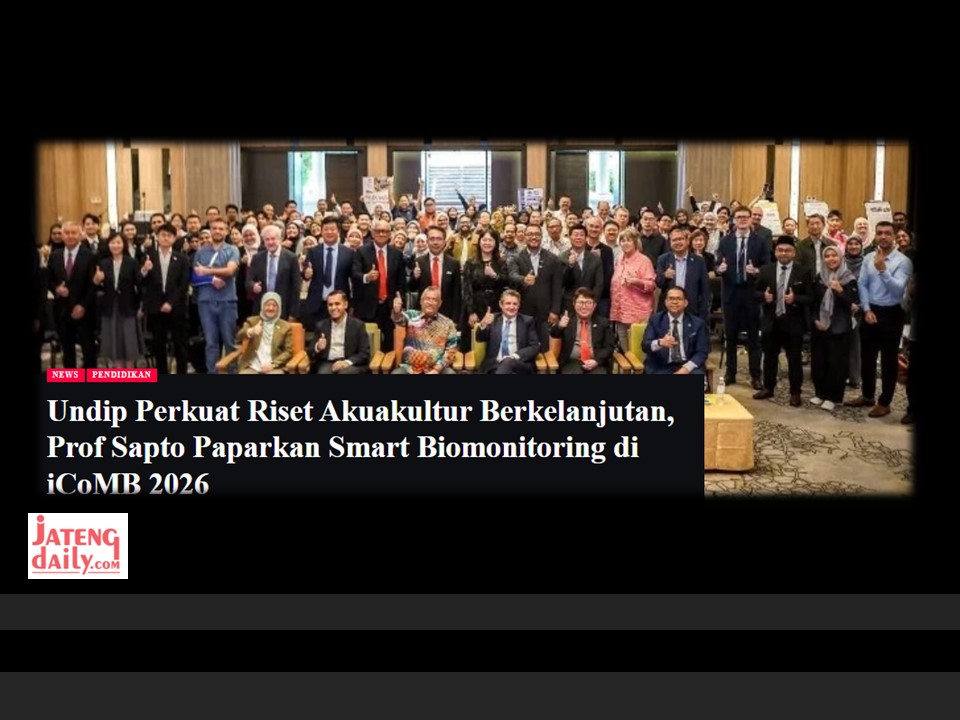
KUALA LUMPUR — The modern aquaculture sector continues to push toward resilient, eco-friendly blue food production systems. In an effort to strengthen national research contributions on the global stage, Universitas Diponegoro (Undip) showcased its breakthrough marine cultivation technology at the 3rd International Conference in Marine Biotechnology 2026 (iCoMB 2026), held by Universiti Malaysia Terengganu (UMT) in Kuala Lumpur, Malaysia (22-23/9/2026).
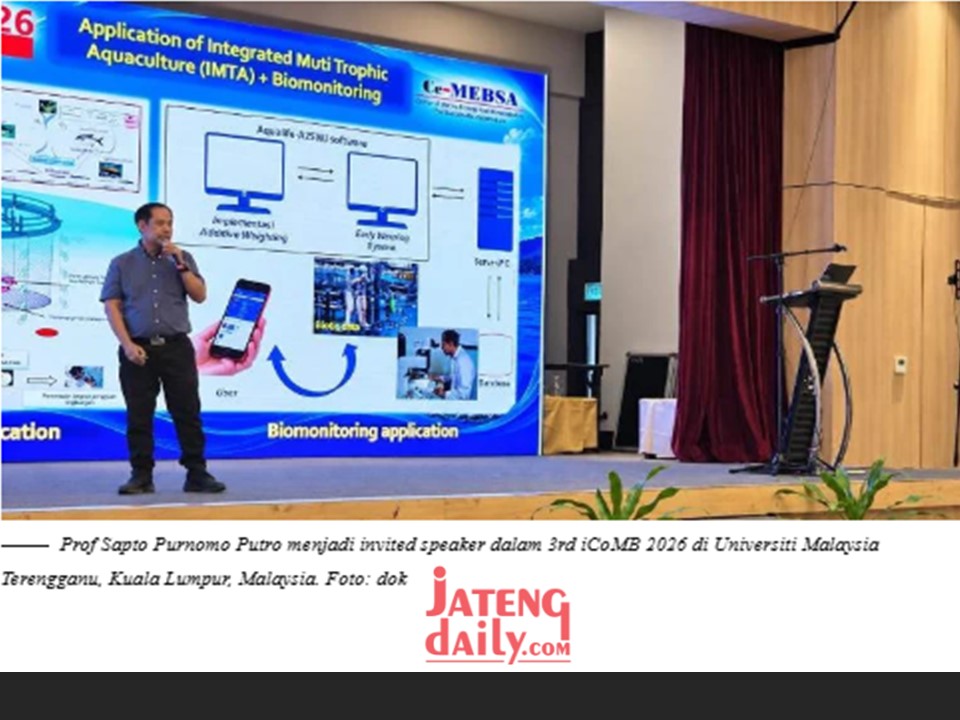
Centering on the theme “Advancing Marine Biotechnology for Ecosystems and Societal Well-Being,” the international forum featured Prof. Sapto Purnomo Putro, Ph.D.—Professor at Undip’s Department of Biology (FSM) and Head of the Center of Marine Ecology and Biomonitoring for Sustainable Aquaculture (Ce-MEBSA)—as an invited speaker.
During his presentation, Prof. Sapto delivered an address on modern Integrated Multi-Trophic Aquaculture (IMTA) systems grounded in Ecosystem-Based Aquaculture (EBA). The IMTA approach co-cultures multiple species from different trophic levels within a single system, allowing natural nutrient recycling to minimize aquaculture waste and maintain ecological balance.
Beyond traditional IMTA, Prof. Sapto and an interdisciplinary research team introduced an advanced 10D-IMTA system coupled with Smart Biomonitoring technology. This collaborative effort yielded the Early Warning System–Simple Additive Weighting (EWS-2SWJ), an early detection system capable of monitoring water parameters—such as pH, temperature, salinity, and dissolved oxygen—alongside sediment characteristics and macrobenthic community structures.
This technological advancement involved key academics and practitioners, including Erwin Adriono, Satriyo Adhy, Dr. Muhammad Helmi, and Imam Kadarisman (PT RAI). The Undip team is also currently refining the Aqualife-EWS-A2SWJ platform alongside Satrio Adhy and Arsyad G. Saputro to strengthen data-driven decision-making.
“Integrating modern IMTA infrastructure, smart monitoring, and ecological indicators is key to driving efficiency in future maritime aquaculture. This approach boosts seafood productivity and quality while lowering ecological risks amid climate change,” noted Prof. Sapto.
Undip’s active participation in this international event highlights its innovative research while reinforcing global academic networks in marine biotechnology, with Undip serving as a co-organizer alongside UMT’s Institute of Climate Adaptation and Marine Biotechnology (ICAMB).
This news story was also published on jatengdaily.com