
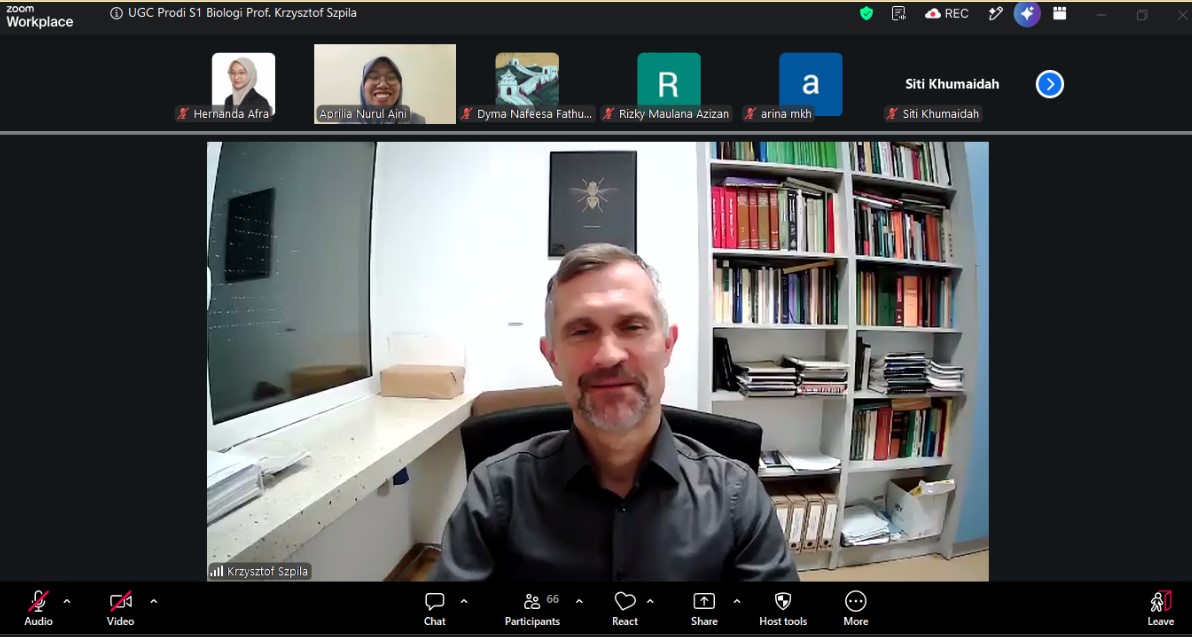
Semarang – The Bachelor of Biology Study Program, Faculty of Science and Mathematics (FSM), Diponegoro University (Undip), held an international guest lecture for the Entomology course on Thursday, October 22, 2026. Held online via Zoom Meeting from 19:00 to 20:40 WIB, the event featured international entomology expert Prof. Krzysztof Szpila from Nicolaus Copernicus University, Poland. A total of 72 participants attended the session.
The guest lecture, titled “Blowflies (Diptera: Calliphoridae): Diversity, Ecology and Forensic Importance,” covered the diversity, biological characteristics, ecological roles, and utilization of blowflies in the field of forensic entomology. The session was moderated by Aprilia Nurul Aini, S.Si., M.Si., from the Department of Biology, Diponegoro University.
In his presentation, Prof. Szpila explained that flies belonging to the Calliphoridae family play diverse ecological roles. Although many species are known as scavengers or necrophagous organisms, the family also includes species that function as parasites, parasitoids, and predators. Notably, non-necrophagous taxa are reported to be more diverse than necrophagous ones. Additionally, several Calliphoridae species are synanthropic, meaning they are closely associated with human inhabited environments.
One of the main topics discussed was the application of blowflies in forensic entomology, particularly for estimating the minimum post-mortem interval (minPMI). Information regarding species identification, development, and ecological characteristics of flies can assist in forensic investigations. Therefore, understanding the diversity and biology of flies serves as a crucial aspect in applying entomology to support death investigations.
Prof. Szpila also highlighted developments in biosystematics and phylogeny research of Calliphoridae. Advances in studying evolutionary relationships and systematics within this group provide a scientific framework to better understand species diversity and relationships among taxonomic groups.
The lecture material was presented with reference to various scientific publications in international journals, covering biosystematics, population density, species diversity, habitat association, and dispersal patterns. These aspects demonstrate that entomological research extends beyond insect identification by integrating taxonomic, ecological, and evolutionary approaches to understand organism distribution and their roles in the environment.
The event offered participants an opportunity to broaden their insights into international entomological research developments. Through a direct presentation by an expert specializing in Calliphoridae, attendees gained valuable perspectives on the connection between fundamental insect diversity studies and their forensic applications.
Organizing this international guest lecture aligns with the efforts of the Bachelor of Biology Study Program at FSM Diponegoro University to enrich the learning experience, expand scientific horizons, and bridge course content with current research trends. The event is expected to strengthen participants’ understanding of the importance of insect biosystematics and ecology in advancing science and practical applications across various fields.