
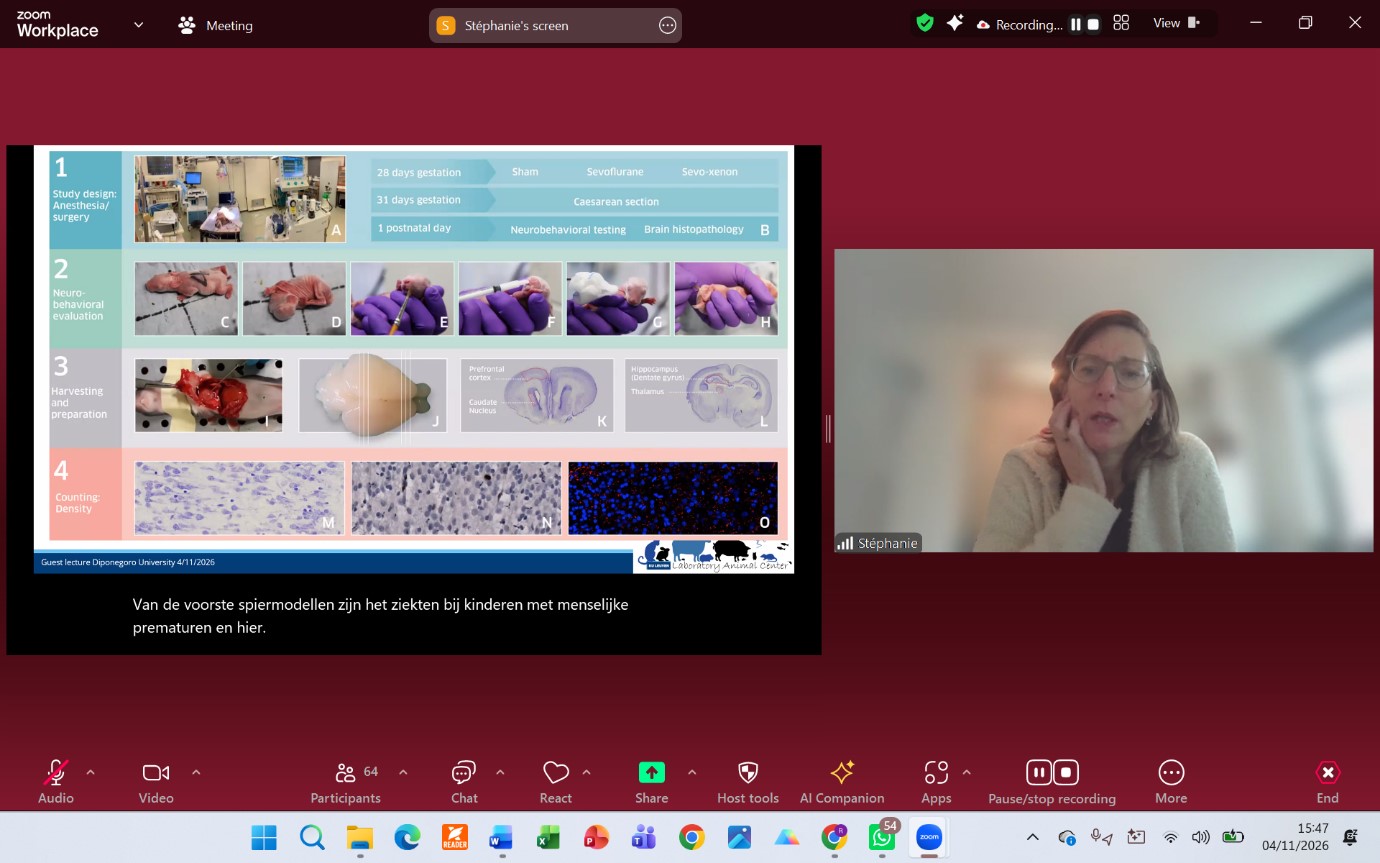
Semarang, — The Undergraduate Program in Biology, Faculty of Sciences and Mathematics (FSM), Universitas Diponegoro (Undip), hosted an international guest lecture for the Experimental Animal Handling course on Wednesday, November 4, 2026. The event, held online via Zoom Meeting from 15.30 to 17.20 WIB, featured Dr. Stéphanie De Vleeschauwer, DVM, PhD, Dipl. ECLAM, from the Laboratory Animal Center, KU Leuven, Belgium. A total of 65 participants, consisting of students and lecturers, attended the event. This guest lecture is part of the Undip Global Classroom (UGC) program under the framework of Undip’s World Class University (WCU) initiative.
Dr. Stéphanie presented two topics during the guest lecture: “The Use of Non-Rodent, Mammalian Species in Biomedical Research” and “Pain and Analgesia in Lab Animals.” In the first topic, she outlined the use of non-rodent mammals in biomedical research conducted at the KU Leuven laboratory, including rabbits, sheep, pigs, and macaque monkeys. For instance, pregnant sheep are utilized as in utero surgical models to study congenital abnormalities such as spina bifida and gastroschisis in gynecological research. Additionally, housing criteria and termination methods aligned with animal welfare principles were presented for each laboratory animal discussed. In the second topic, Dr. Stéphanie explained pain management in laboratory animals, including clarifying several misconceptions surrounding the use of analgesics. She emphasized that the side effects of untreated pain must also be taken into consideration.
The organization of this international guest lecture is part of the efforts by the Undergraduate Biology Study Program at FSM Undip to enrich students’ learning experiences and introduce current practices in laboratory animal handling oriented toward animal welfare. Through a direct presentation by an international expert, participants gained insights into species selection and pain management in biomedical research. This activity is also expected to strengthen students’ understanding of responsible and ethical research. (RFA)