
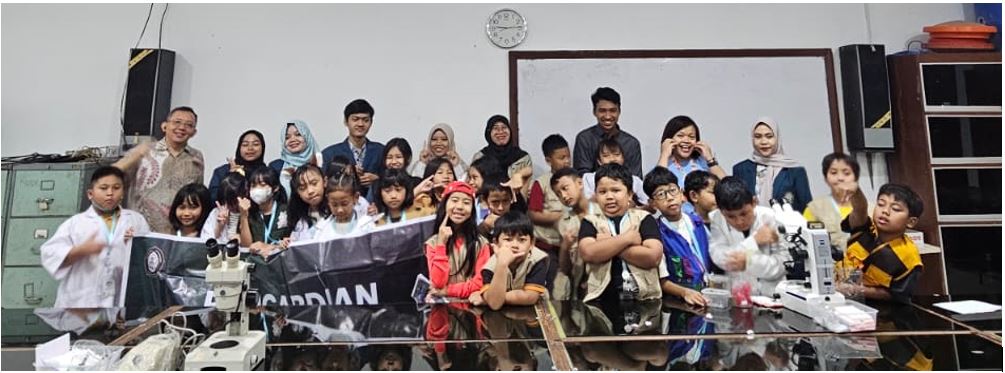
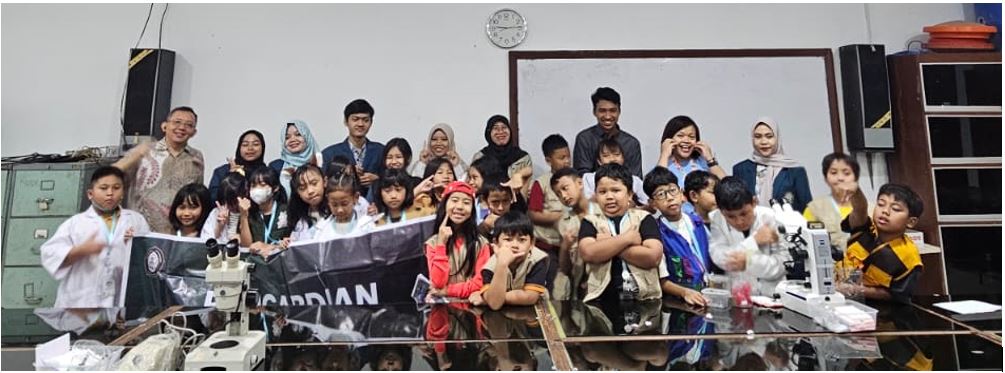
Semarang – The community service team from the Ecology and Biosystematics Expertise Group (KBK), Department of Biology, Faculty of Science and Mathematics (FSM), Diponegoro University (UNDIP) organized a community engagement activity for 23 third-grade students from SD Bukit Aksara Semarang on February 13, 2026, at the FSM UNDIP Basic Biology Laboratory. Through visual exploration-based learning, students were introduced to insect diversity while gaining an understanding of how insect body structures, organ functions, and environmental interactions are interconnected within an ecosystem.
The event began with an introduction to various types of insects and their biological characteristics, followed by direct observation of grasshopper and cricket specimens using magnifying glasses. Guided by lecturers and university students, the elementary pupils identified spiracles as part of the insect respiratory system and learned about the relationship between body morphology and organ function in supporting life within natural habitats. The learning experience became even more engaging as participants were introduced to simple techniques for maintaining insect collections—specifically cleaning mold off specimens—while learning the importance of preserving biodiversity collections for educational and research purposes.
“Insects were chosen as a learning medium because they are easily found in our surroundings, exhibit high diversity, and serve as an accessible entry point to understanding biodiversity, adaptation, and organism interactions within ecosystems,” said the Head of the Community Service Team, Rully Rahadian, who is also a lecturer in the Biology Study Program at FSM UNDIP.
Throughout the session, students gained more than just knowledge about biodiversity; they practiced scientific observation, recorded findings, engaged in group discussions, and cultivated curiosity about organisms in their environment. Based on observations and reflections, the students demonstrated an increased understanding of the role insects play in ecosystems, the significance of maintaining scientific collections, and the link between an organism’s structure and its environmental adaptation. During an exploration session with Anggiresti Kinasih, a Taxonomy and Biosystematics lecturer at FSM UNDIP, students also learned about various species of fungi that grow on insects as well as those that can damage insect specimens.
This initiative represents an implementation of the Higher Education Tri Dharma (Three Pillars of Higher Education), strengthening collaboration between the FSM UNDIP Department of Biology and SD Bukit Aksara Semarang to boost early childhood science literacy. Furthermore, the program supports the achievement of the Sustainable Development Goals (SDGs)—specifically SDG 4 (Quality Education) through experiential science learning, SDG 15 (Life on Land) by promoting awareness of biodiversity and conservation, and SDG 17 (Partnerships for the Goals) through the strategic partnership between higher education institutions and schools.
“As part of a expertise group focusing on ecology, biosystematics, and biodiversity conservation, the Ecology and Biosystematics team continues to develop educational programs that deliver hands-on, collection-based learning experiences. Through this initiative, we aim to foster biodiversity literacy, environmental awareness, and a passion among the younger generation for biological sciences and the conservation of Indonesia’s natural resources,” Rully added.